
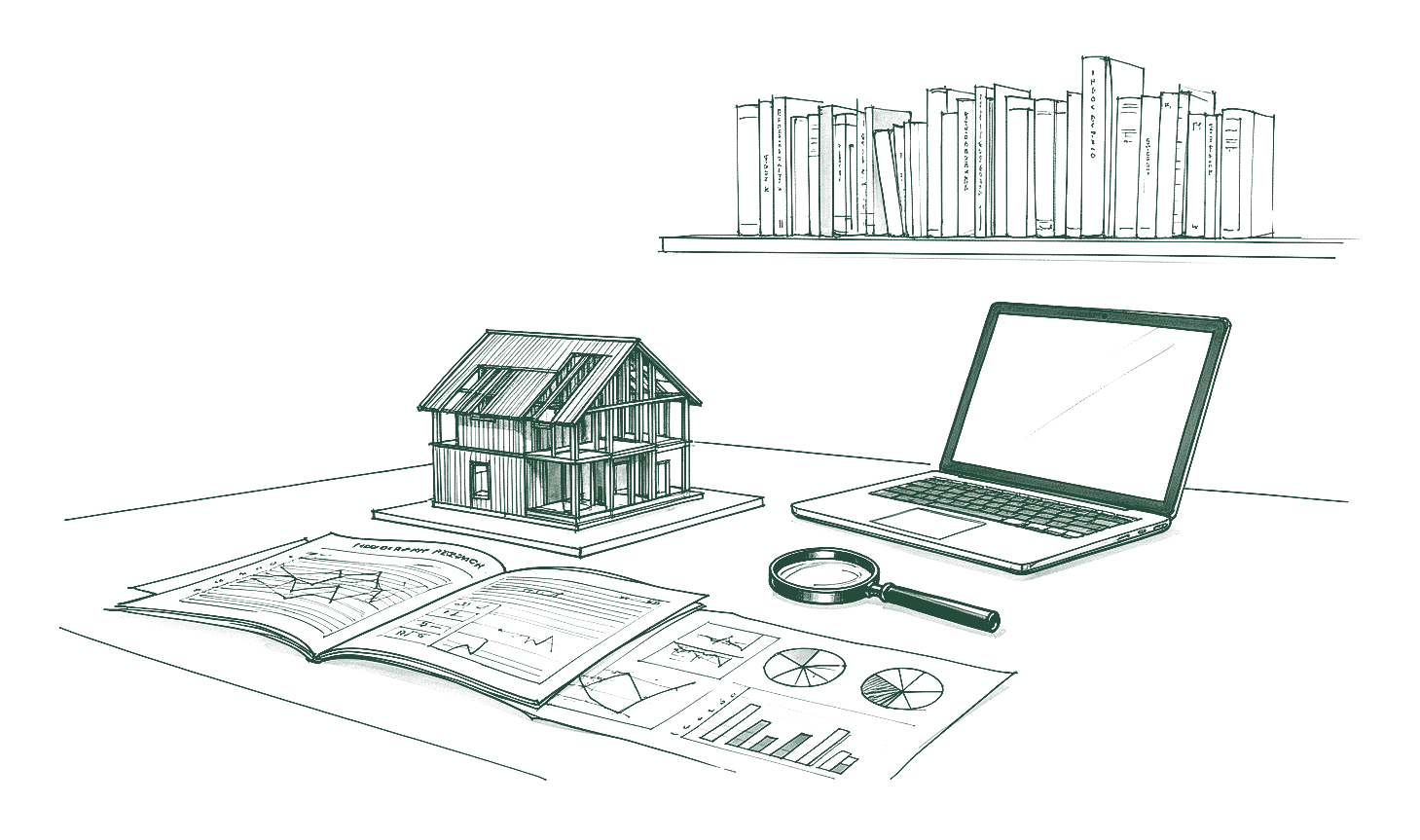
Research as a way of asking better questions
Working with university researchers has changed how we frame problems. Research does not hand us finished answers so much as it sharpens the questions: what does the evidence actually say about how people live in a space, which assumptions are we carrying without checking them, and which of our instincts are worth testing rather than trusting. The habit has bled into the rest of the practice, to the point where 'we should test that' has become a normal sentence in design conversations.
The value is not academic for its own sake. It is a discipline that keeps us from designing to a version of life that does not exist, and from borrowing other people's conclusions without asking whether they apply to the house in front of us.
How findings flow back into design decisions
The most useful research is the kind that travels into a real project. A finding about daylight and how people actually use a room changes where we place a window and what we assume that window is for. A finding about overheating changes the priority we give to orientation and shading before the floor plan is fixed, not after. When evidence sits in a report it is interesting; when it sits inside a decision it is worth something.
We treat research the way we treat site conditions: as information that should be in the room before decisions are made, not as decoration added afterwards. And when a finding contradicts an instinct, the finding wins. That is not always comfortable, but it is the whole point of bringing evidence into a design conversation in the first place.
Some findings arrive as firm numbers and others as tendencies with limits and context attached. Learning to read the difference — what the evidence establishes, and what it only suggests — is a skill we have picked up slowly. It stops us from treating a small study as a universal rule.
What this means for the work we do
The result is a design process that is comfortable saying 'we should test that' rather than 'we already know'. It is a quieter kind of confidence than the industry often performs — one built on checking rather than asserting. We find that holds up better when a building has to actually work, because the decisions that survived scrutiny are the ones we can stand behind.
It also keeps us honest about our own limits. Research is a standing reminder that the gap between a good idea and a buildable, liveable one is exactly where the work happens, and that no amount of confidence closes that gap on its own.
The practical effect shows up in the questions we ask early in a project: how do you actually use this room, where does the sun sit at the time you are home, what has already worked or failed in the houses you have lived in. Those are research questions asked in plain language, and the answers do real work in the design.
Why we write about it
We share this because it is the part of how we work that is hardest to see from the outside. A finished drawing does not show which assumptions were tested and which were discarded. But for an owner choosing who to work with, that invisible part matters: it is the difference between a design that looks right and one that was arrived at carefully.
If the idea of evidence-led design sounds remote, it is not. It is just a slower, more careful version of what a good designer has always done — ask before deciding, and let the answer change the design.